Choosing a Car Vacuum That Reaches the Dirt
Some links in my articles are affiliate links. I may earn a commission when you buy through them.
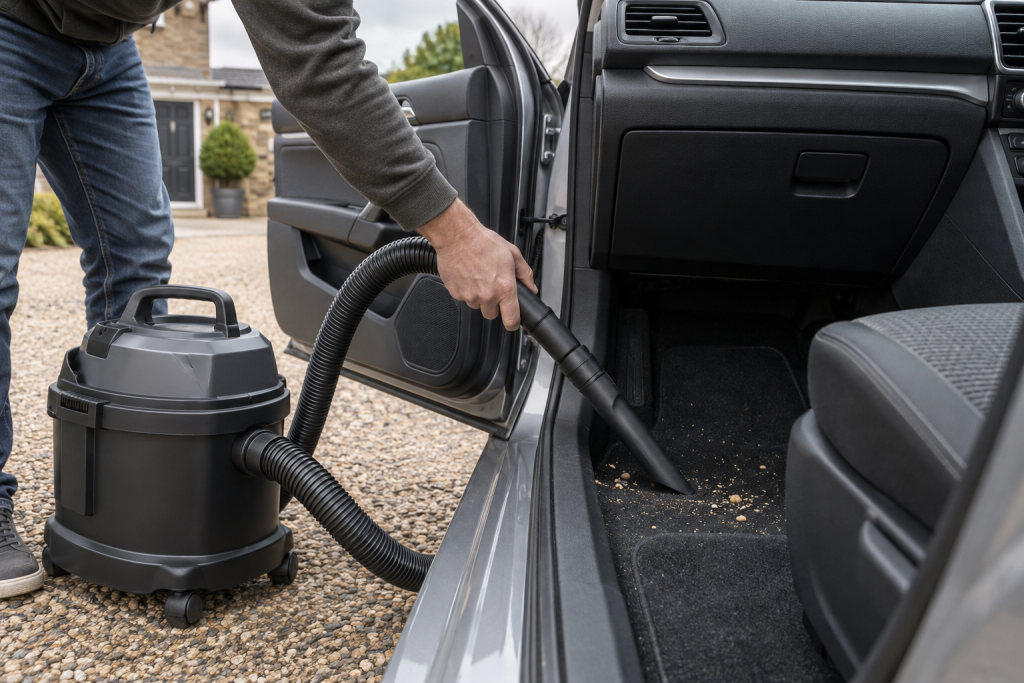
The easy patch in the middle of a floor mat tells you surprisingly little about a car vacuum. I’d look at the gap beside the seat, the seams and the far footwell first. Choose a machine that reaches those places comfortably and the regular clean becomes much more thorough.
My choice for quick dry interior work
The JML Go Vac Pro has been useful for my regular dry cleans. Its crevice attachment helped at seat seams and footwell edges, and having no cable alongside the car made those smaller jobs easy to organise.
That is the role I’d buy it for: keeping up with loose dry debris in a car that gets cleaned regularly. If you face large amounts of grit, several vehicles or liquid recovery, choose the machine around that wider workload.
Check the attachment before the headline power
Measure the narrowest gap you want to reach. Look at the tool’s tip, its wider shoulder and how much room your hand needs behind it. A nozzle can fit the opening while the rest of the machine stops it reaching the bottom.
| Detail | Why it matters inside a car |
|---|---|
| Crevice-tool shape | Reaches seams and console gaps without forcing the fitting |
| Hose or body reach | Lets you work the far footwell in a comfortable position |
| Collection capacity | Determines how often you stop to empty the machine |
| Filter care | Keeps regular cleaning and replacement manageable |
| Power arrangement | Must suit the socket, cable route or charging time available |
Compare like-for-like specifications. Different quoted power and suction measures do not always describe the same thing, and an attractive number won’t compensate for a tool that cannot reach your seat rails.
Handheld or larger vacuum?
A compact cordless model is convenient for short, frequent tidies and limited storage. A larger machine can make sense for heavier debris or repeated work, particularly with a flexible hose and useful attachments.
For customer cars, allow time to empty the collection chamber, clean the filter and prepare the machine between vehicles. For home use, think about where it will live and whether charging fits your routine. The easiest machine to get out is often the one that gets used regularly.
Keep wet cleaning as a separate decision
Check explicitly whether a vacuum is designed and configured to recover liquid. A dry handheld is for dry work. An upholstery extractor adds controlled solution application and recovery for compatible fabric, which is a different function again.
If seat washing is your main reason for shopping, read the wet-and-dry vacuum versus extractor guide first. It will save you buying a machine that does only the preparation stage.
Give any vacuum a fair working routine
Remove mats and loose belongings, move the seats through their normal adjustment and start with the accessible seams and edges. Use slow, deliberate passes, empty when needed and revisit the gaps after brushing out loose dust.
The Go Vac Pro is my straightforward choice for that regular dry upkeep. Pair it with the interior-cleaning order so dust loosened during wiping is collected before you finish.