Wet-and-Dry Vacuum or Extractor: What Do Your Car Seats Need?
Some links in my articles are affiliate links. I may earn a commission when you buy through them.
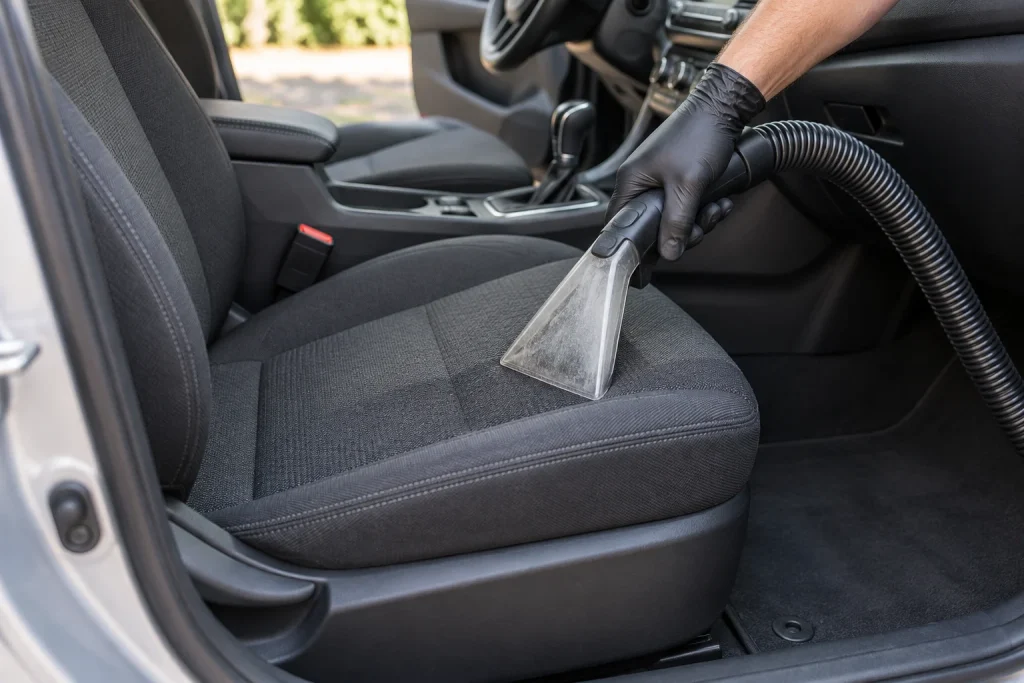
If you want to wash fabric seats, the important difference is whether the machine sprays cleaning solution as well as collecting it. A wet-and-dry vacuum and an extractor solve different jobs. Buy the missing function in your setup, and a vacuum you already own may cover the preparation stage perfectly well.
Choose by the work waiting in the car
| Your main job | The useful machine |
|---|---|
| Crumbs, dust and grit | A dry vacuum with suitable attachments |
| Dry debris plus appropriate liquid pickup | A wet-and-dry vacuum in the correct configuration |
| Washing compatible textile upholstery | A spray extractor, with a separate dry-vacuum stage where required |
The Go Vac Pro has been useful to me for dry seam and footwell cleaning. For larger mains-powered vacuum work and suitable wet pickup, the Kärcher WD 3 is worth comparing. For recurring fabric washing, I’d consider the SE 3 Compact alongside the dry vacuum you already use.
The difference is the solution circuit
A wet-and-dry vacuum can recover appropriate liquid when set up for it. An extractor also has a fresh-solution supply and controlled spray, delivering cleaner to the textile and recovering dirty liquid through the tool.
Adding a transparent nozzle to a vacuum does not create that spray circuit. Equally, the SE 3 Compact has no dry-vacuum function: it needs another machine to deal with crumbs and loose grit first.
Compare the useful specifications
| Detail | WD 3 17L | SE 3 Compact |
|---|---|---|
| Main function | Dry debris and suitable wet pickup | Spray extraction of compatible textiles |
| Tank arrangement | 17L collection container | 1.7L fresh solution; 2.9L recovery |
| Cable and hose | 4m cable; 2m hose | 3.6m cable; 1.9m hose |
| Useful supplied tools | Crevice and wet/dry floor nozzles | 88mm upholstery and spray-extraction crevice tools |
The 17L and 1.7L figures describe different things: dirty-material collection versus fresh-solution supply. They don’t show that one machine will wash ten times as much upholstery. Similarly, electrical input is not a shared cleaning-performance score.
Compare the exact current package and the tool you will use between your seat’s bolsters. A long operating radius is less helpful if the upholstery nozzle cannot be guided comfortably into the far corner.
Picture filling, emptying and storing it
A compact extractor can fit a small cupboard while still needing several refills during a larger clean. Check where you will fill the fresh tank, dispose of recovery water and flush the hose afterwards.
For repeated customer work, those interruptions belong in the schedule alongside cleaning. For occasional home use, convenient storage and easy cleanup can decide whether the machine remains useful after its first outing.
Build drying into the job
Confirm that the seats support wet cleaning, vacuum first and use the machine’s specified detergent. Work controlled passes, then recover residual solution using the prescribed suction-only and rinse stages. Keep moisture away from seat electronics.
The SE 3 Compact method includes overlapping backward tool passes and system flushing after use. Include that cleanup in the time allowance.
Allow the seats to dry properly in suitable ventilated conditions. The liquid collected in the recovery tank cannot tell you how much moisture remains in the filling. A damp, cold day changes the schedule even when the machine is unchanged.
Buy or hire for a one-off clean?
Compare a real purchase quote with hire that includes the correct upholstery attachment. Include detergent, delivery, maintenance and any useful resale value. A refundable deposit affects cash needed at collection but is not a permanent hire cost.
For equivalent sessions, a useful calculation is: (purchase plus ownership extras minus resale) ÷ (hire cost per session minus owned running cost per session). It only helps when the denominator is positive and the jobs are comparable.
For one major clean, suitable hire can be convenient. For regular smaller fabric jobs, ownership becomes more attractive when you have storage and drying space. Choose the compact extractor for its washing function; choose the larger wet-and-dry machine when vacuuming and liquid pickup are the jobs you need.
Continue with the fabric-seat method for the material and drying decisions around the machine.