Car APC Dilution Ratios for 500ml and 1L Bottles
Some links in my articles are affiliate links. I may earn a commission when you buy through them.
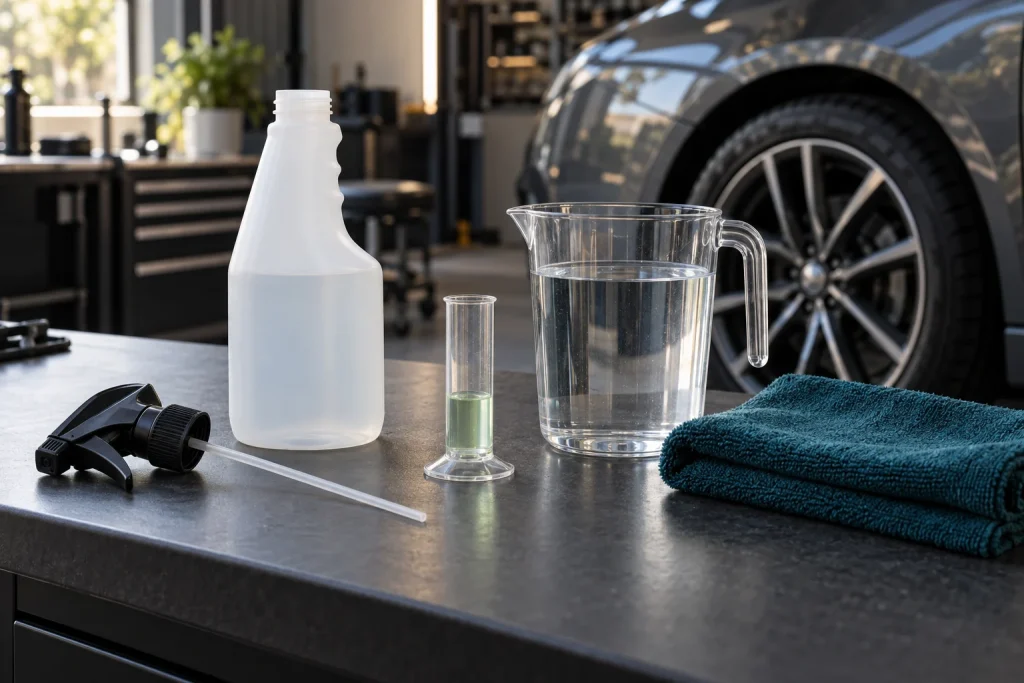
A 1:10 mix can catch you out because it often means one part cleaner plus ten parts water: eleven parts altogether. Once the notation is clear, filling a working bottle is straightforward. These tables do the arithmetic so you can concentrate on the right strength for the product and surface.
Read the order of the ratio first
In the first table, ratios are concentrate:water. At 1:10, divide the finished volume by eleven to find the concentrate, then make up the rest with water.
Some makers write water:product instead. Farécla uses that order for G3 Pro Multicleaner: its 10:1 interior dilution means ten parts water to one part product, equivalent to this table’s 1:10. Read the words beside the number before mixing.
Concentrate-to-water ratio table
Amounts below are millilitres for the stated finished volume, rounded to a practical decimal place. Choose a row only when the product’s task instructions support that concentration.
| Concentrate:water | 500ml: cleaner + water | 1L: cleaner + water |
|---|---|---|
| 1:5 | 83.3 + 416.7 | 166.7 + 833.3 |
| 1:10 | 45.5 + 454.5 | 90.9 + 909.1 |
| 1:15 | 31.3 + 468.7 | 62.5 + 937.5 |
| 1:20 | 23.8 + 476.2 | 47.6 + 952.4 |
| 1:30 | 16.1 + 483.9 | 32.3 + 967.7 |
| 1:40 | 12.2 + 487.8 | 24.4 + 975.6 |
| 1:100 | 5.0 + 495.0 | 9.9 + 990.1 |
For another bottle size, use cleaner = finished volume ÷ (water parts + 1). A 750ml batch at 1:10 needs about 68.2ml cleaner and 681.8ml water.
Adding 50ml cleaner to 500ml water produces 550ml at 1:10. Adding 50ml and topping up to 500ml produces a 10% mixture, which is 1:9. Decide whether you are measuring water or finished solution before filling the bottle.
When the instructions use a final percentage
For a volume percentage, multiply the finished volume by the percentage divided by 100. The remaining volume is water.
| Final concentration | 500ml: cleaner + water | 1L: cleaner + water |
|---|---|---|
| 0.5% | 2.5 + 497.5 | 5 + 995 |
| 1% | 5 + 495 | 10 + 990 |
| 2% | 10 + 490 | 20 + 980 |
| 4% | 20 + 480 | 40 + 960 |
| 5% | 25 + 475 | 50 + 950 |
| 10% | 50 + 450 | 100 + 900 |
These are volume calculations. A product specifying grams or dosing by mass needs its own measuring method; an unfamiliar concentrate is not automatically the same density as water.
Choose the strength for the actual job
G3 Pro Multicleaner is useful for marked cabin areas, with residue removed using a fresh cloth. Check from the driving seat as well as the doorway to spot little remnants around the controls.
Farécla permits dilution for this product, with task-specific ranges. Its interior guidance reaches ten parts water to one part product; exterior maintenance uses a different range. Match the task and material, then use the table to measure that chosen dose.
A ratio from another cleaner is not interchangeable. Two formulas at 1:10 can have different chemistry and removal requirements. Compare the appropriate working method for each rather than using the largest dilution number as a quality score.
Mix a bottle you can identify next month
Use a clean, suitable chemical bottle and dedicated measuring equipment with markings you can read at the dose required. Follow the product’s mixing order and protective-equipment instructions. Allow working headspace for the trigger rather than filling to the brim.
Label the full product, ratio order, intended task and mixing date. “Interior cleaner” is too vague if another bottle uses a different formula. Keep mixtures separate and use the maker’s storage advice.
Start with an appropriate small batch. If the result needs improvement, check cloth cleanliness, agitation and residue removal before increasing concentration. A sticky surface may need cleaner removal rather than more chemical.
A foam lance adds another dilution
With a hand trigger, the bottle mixture is what reaches the surface. A foam lance draws that mixture into more water from the washer. A target panel concentration therefore cannot simply be copied into the reservoir.
For example, if measured reservoir solution makes up 10% of the output and the product specifies a 4% panel concentration, the reservoir would need 40% concentrate: 4 ÷ 0.10. This is arithmetic for those stated inputs; your actual draw rate must be measured using the product’s calibration method.
The snow-foam guide explains that stage of the wash. Keep a written recipe for each product and setup, with the units included, so the next clean begins with a repeatable mixture.