Some links in my articles are affiliate links. I may earn a commission when you buy through them.
There’s something particularly annoying about washing a car carefully, then spending the last ten minutes pushing water around with a tired cloth. For the main drying job, I’d choose the CarMax XXL drying towel if you can comfortably control a 90 × 60cm towel. For doors, lower panels or anyone who finds a big wet towel cumbersome, the CarMax XL drying towel is the more manageable 60 × 40cm option. Keep a few Amazon Basics three-pack cloths aside for the smaller finishing jobs.
I like a large towel on a roof or bonnet, where it has room to work. Around mirrors and badges, a small clean cloth is much easier to place exactly where you need it. You don’t have to make one towel do absolutely everything.
Before comparing towel specifications, think about where you stand beside your car. A broad bonnet is fairly forgiving. A low sill, a door beside a garage wall and the far side of an SUV roof are different matters. You need to reach the water without leaning a zip, buckle or the rest of the towel against the paint.
For a low car, fold the towel so its bottom edge stays well clear of the driveway. If that leaves an awkward bundle in your hand, choose a smaller towel and change it more often. A second manageable cloth is preferable to a large corner brushing the ground unnoticed.
The same applies to a tall car. A larger towel doesn’t give you a longer safe reach. Work from a stable position, keep control of its edges and leave the inaccessible part until you have sensible access. Don’t stretch across the roof with a wet towel dangling down the opposite side.
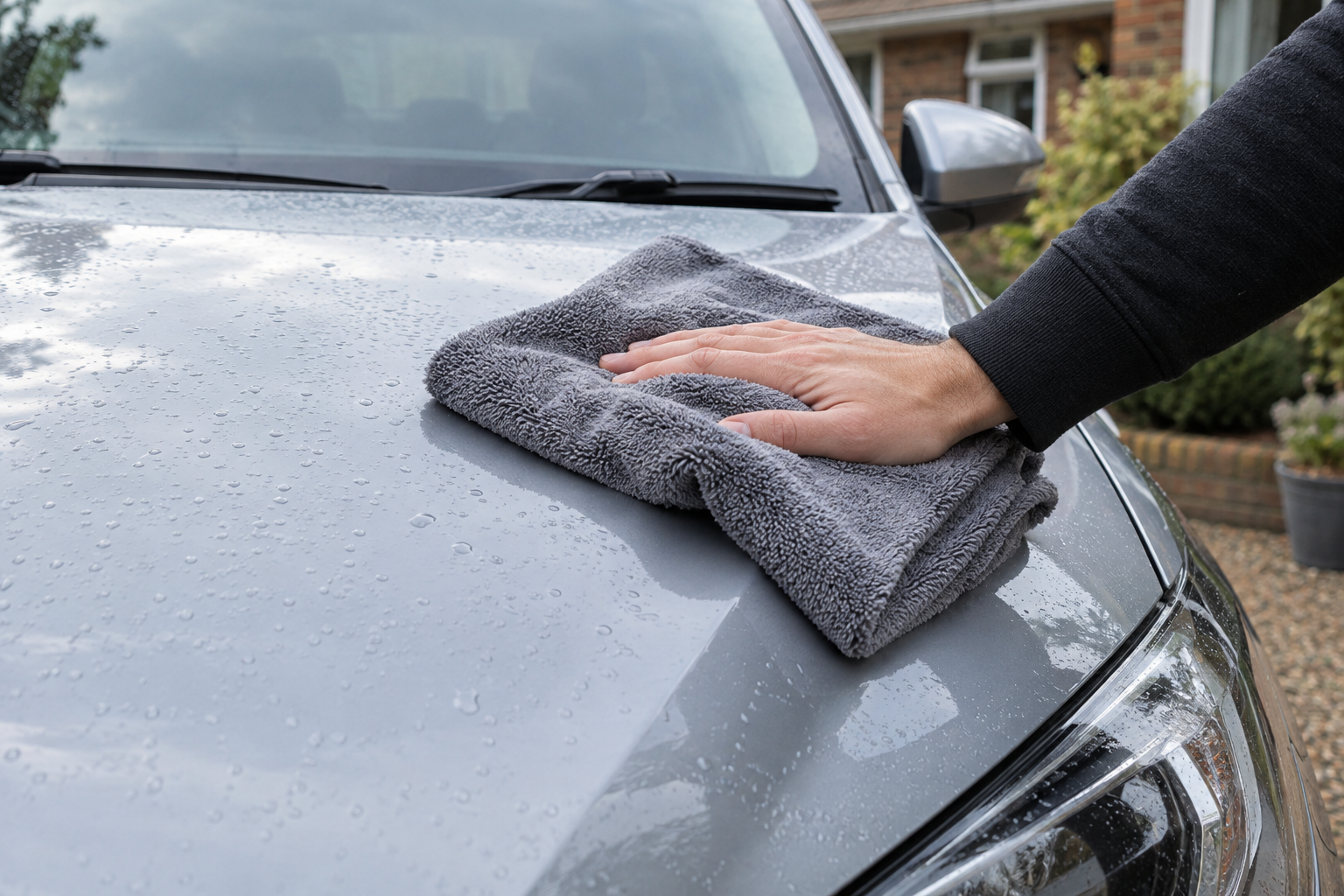
Fold a towel into a face you can control. Keep its loose edges clear of the ground as you move down the car.
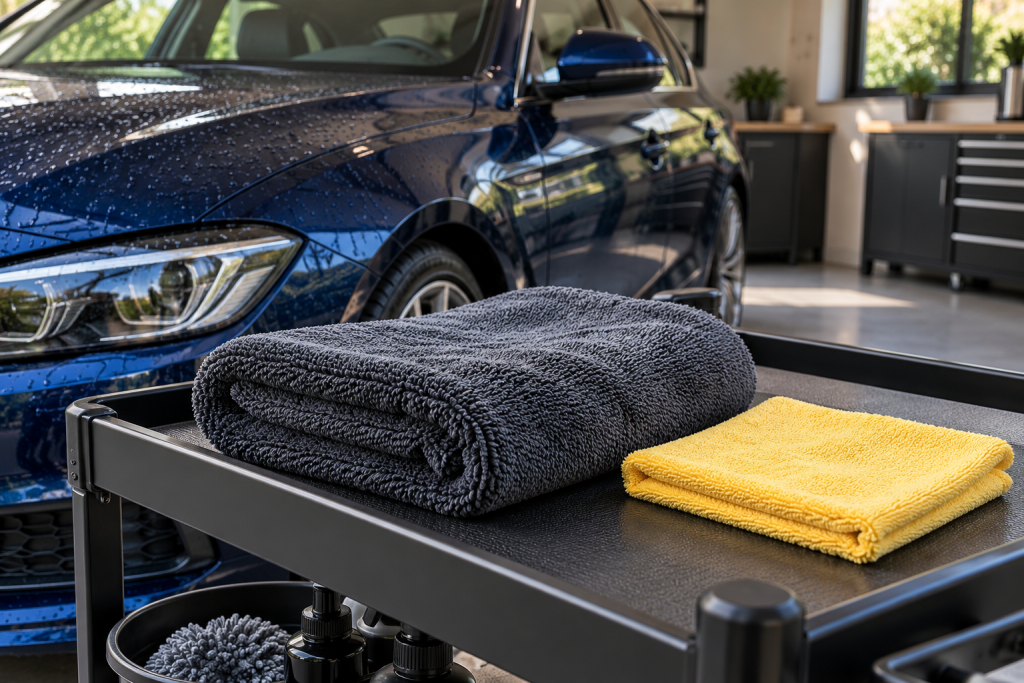
The CarMax XXL is a double-sided twisted-loop towel, specified at 90 × 60cm and 1400gsm. It suits the big open panels where a small cloth feels as though you’re drying the car a postcard at a time. You can work with a broad face, then fold it for the next area rather than carrying the whole thing spread out around the car.
With this towel, I keep turning to a clean face as moisture and residue build up. That matters more than trying to complete an impressive uninterrupted pass. After the main drying, check the panel from the side; a narrow wet line behind the cloth means you need a fresh area or a different towel, rather than more pressure.
I’d pair it with smaller finishing cloths instead of using its corner behind a badge and then returning that corner to the bonnet. Once a cloth has been into a dirty shut or around a lower edge, put it aside for that job.
CarMax XL: when control matters more than coverage
The CarMax XL is the 60 × 40cm alternative in the same double-sided, 1400gsm twisted-loop range. That smaller footprint is the reason to choose it: less loose material to manage beside a door, easier folding and less towel to bunch up in your hands.
It also makes sense if you prefer working panel by panel in a narrow parking space. Keep the next clean towel within reach before you start, particularly if you’re drying a larger car. Don’t keep going with a wet cloth simply because the listing calls it a drying towel.
If your current large towel is comfortable and stays clean, there’s no need to replace it just to own both sizes.
Small finishing cloths earn their space
The Amazon Basics cloths have a higher-pile side for picking up liquid and a lower-pile side for buffing. Their 40.6cm-square format is handy for a controlled fold around mirrors and for catching the drips that appear after you’ve moved the car.
Keep those cloths clean and separate from product-removal cloths. One that has just buffed wax or cleaned an oily door hinge is a poor choice for a final drying check. A pack is useful because you can reserve cloths by task; it isn’t a reason to use every cloth on every surface.
For glass, make sure you’re finishing with a genuinely clean face. If a wipe leaves an oily-looking trail, change the cloth and investigate the residue rather than polishing harder. The microfibre cloth guide explains how I separate the different jobs.
What GSM tells you — and what to check instead
GSM means grams per square metre. It describes fabric mass over an area, so it helps explain why a large, dense towel can become a substantial thing to handle. It doesn’t tell you how much water your particular car will leave behind, or whether you can finish it with one cloth.
Look at dimensions alongside GSM, then at how the towel folds, its edges and the care instructions. A thick cloth that you can’t comfortably control is the wrong choice for you, however impressive the number looks. Likewise, buying a larger towel won’t cure detergent residue in the one you already own.
If the material itself is the sticking point, compare microfibre with natural chamois. They involve different handling and care routines; you don’t need to choose on nostalgia or a headline absorbency claim.
Buy for the next wash as well
Allow somewhere clean to dry and store the towel between washes. A big dense towel needs room to hang open; leaving it bundled in a bucket makes getting ready next time rather less appealing. CarMax specifies a 40°C detergent wash for its twisted-loop towels and says not to use fabric softener because it reduces absorbency. Its care guidance is worth keeping with the towel.
If your existing towel has suddenly become frustrating, try the absorbency checks before buying another. Saturation, contamination and the laundry routine need different fixes.
For a fresh setup, my choice would be the broad-panel towel you can comfortably hold, plus separate small finishing cloths and a clean spare. Then follow the car-drying method and change cloths when they stop collecting water cleanly. That gives each towel a useful job without turning drying into another collection of equipment.